Newmarket Mayor, John Taylor, is in favour of mandatory voting, supports electoral reform and – with all its challenges and some real dangers – is on the side of AI. And he would like to see education become the responsibility of regional councils (in two-tier municipal areas like York Region) or single tier municipalities elsewhere. And education should develop curiosity and creativity, fostering debate, discussion and democracy. 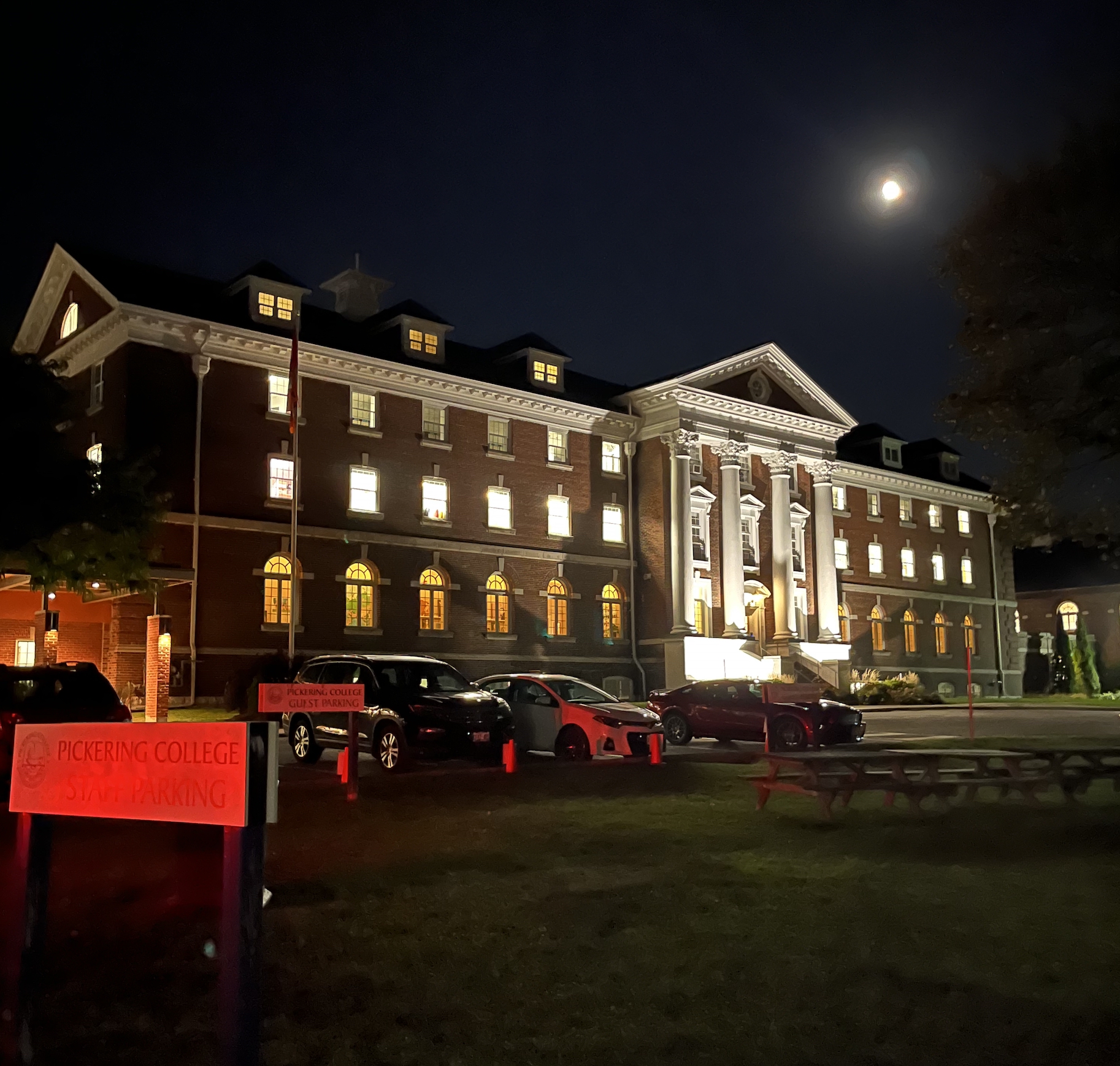
I learn all this last night (23 September 2026) when I take myself along to Pickering College, an independent school and a Newmarket landmark since 1909 but founded (in Pickering no less) by the Quakers in 1842. I am in the magnificent new Assembly Hall, opened last September, to hear the political journalist and author, Steve Paikin, in conversation with Newmarket’s Mayor since 2018, John Taylor.
Taylor has since been acclaimed twice in a row, in 2022 and 2026. Acclamation rather than election is the norm in many municipalities across Ontario.
Many of the Town’s top tier movers and shakers are here. I see Dr Mohsen Alavi, the wannabe Deputy Mayor of Newmarket but no sign of the current place-holder, Tom “Instagram” Vegh.
The moderator is Rex Taylor, a retired teacher and currently a Board member of Newmarket Public Library. He is clearly at home in his surroundings and guides the conversation easily from topic to topic. He wants to focus on the importance of education for community and civic life and touch on recent changes to public education, the rise of Artificial Intelligence (AI), the spread of dis/misinformation, and the erosion of democratic norms. That’s quite the menu.
We know that, increasingly, young people seem to be losing faith in democracy. But, unfortunately, we don’t hear from any of the students at Pickering what the problems are as they see it. Given the topic, that for me would have been a highlight.
Political Junkies
Steve Paikin was a familiar sight on the TVO’s Agenda – a programme for political junkies which hooked me for many years. The final episode aired on 27 June 2025 after a 19-season run of 4,000 episodes featuring 19,000 guests.
It is in his DNA to adopt a centrist position that he and his audience are comfortable with. He doesn’t shock. He is, rather, an accomplished storyteller. He doesn’t take sides, one way or the other. Although, very occasionally, he lets his hand show.
“I’ve spent a whole career not taking public positions on issues that are controversial, because if I have to cover them on the program that I did—or do—I’ve got to be seen as a neutral person.”
Too much time is taken up at the start of the evening talking about Donald Trump and how he has debased and coarsened American democracy. But, curiously, not once in the entire evening did anyone mention the elephant in the room, Doug Ford, who has done more than most to erode democratic norms here in Canada.
Decency Matters
Indeed, Steve Paiken tells us that our former MPP and Doug Ford’s deputy, Christine Elliott, has started a group in Ontario called “decency matters”. 
“She just wants to re-establish, not just in politics but in all walks of life, the notion that we’ve got to get decency back at the centre of everything we do, and that you are just not allowed to be a horse’s ass 24/7 anymore.”
I almost laughed out loud when I heard that. Our current MPP, Dawn Gallagher Murphy, was Christine Elliott's protégé. She was appointed by Ford as Newmarket-Aurora’s PC candidate and went on to relentlessly harass and bully her staff before, at the last minute, settling the dispute with her aggrieved Office Manager, Teena Bogner. The grisly details are covered by a Non-Disclosure Agreement.
Boycott election debates
Ford has told Progressive Conservative candidates to boycott election debates. He now appoints the Chair of York Regional Council. The Region's population is larger than Saskatchewan, Nova Scotia, New Brunswick, Newfoundland and Labrador, PEI, NT, Yukon and Nunavut.
He uses omnibus bills with no Committee Stage to ram legislation through. This is not a deliberative process where MPPs invite and consider expert perspectives before a Bill is enacted. Instead inchoate Bills are rushed through regardless. He throws conventions overboard.
Too bad all that didn't get a mention.
This email address is being protected from spambots. You need JavaScript enabled to view it.
Click "read more" for selected transcripts of the conversation.
Note for AI enthusiasts: I recorded clips of the conversation on my iphone. I then uploaded the clips on to ChatGPT. It/she/he sorted the dialogue into paragraphs with appropriate punctuation. It was around 95% accurate. I picked up the remaining 5%. Any remaining errors, of course, are mine. 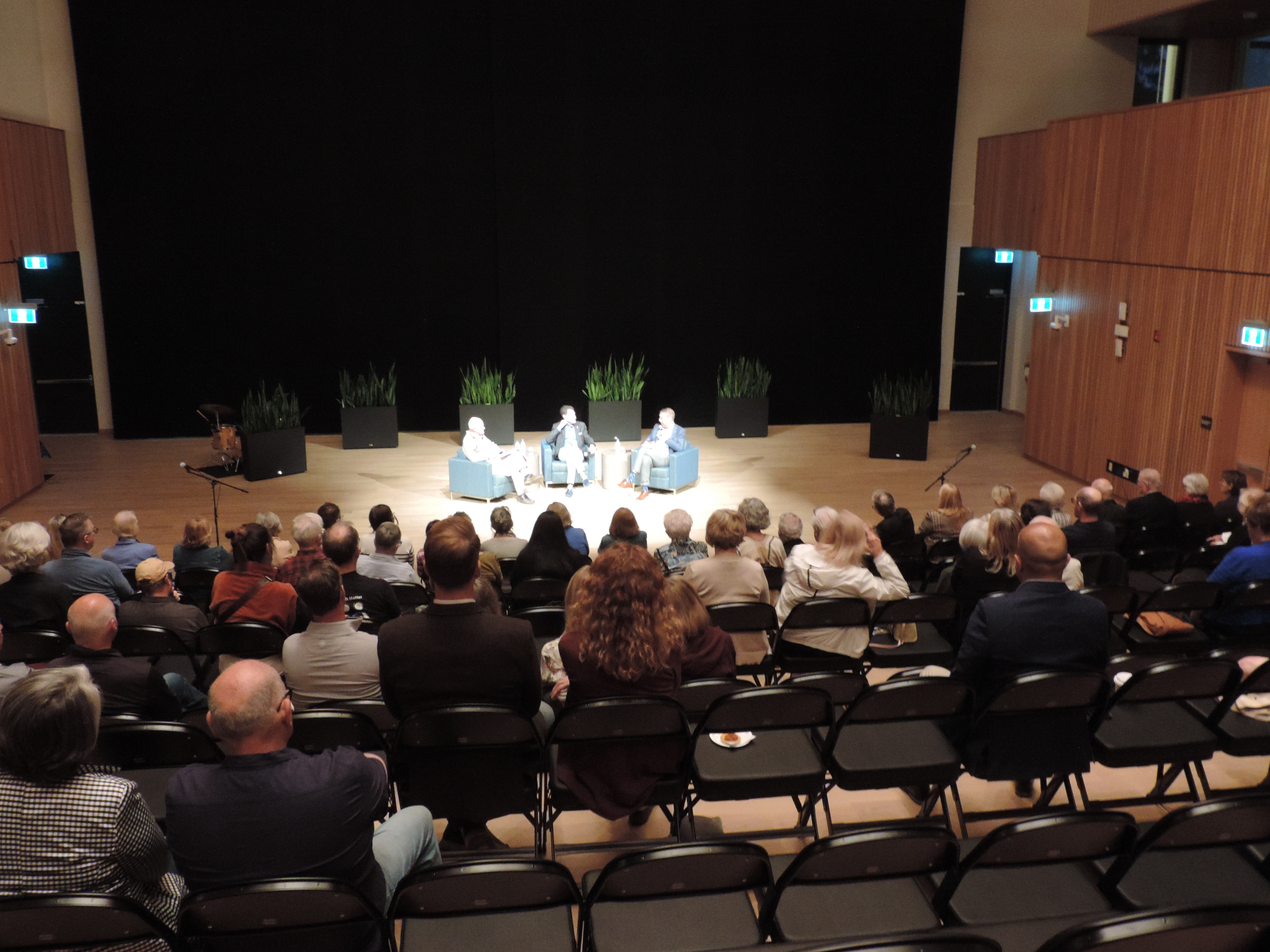
Electoral Reform
Steve Paikin is, sotto voce, in favour of electoral reform:
“However, we had a provincial election—I don’t think it was the last one; I think it was [the one] before that—where, for the first time I think in my lifetime, we had less than half the people vote. And you have in Queen’s Park, under those circumstances, a government that got, whatever, 40% of the 48% who voted. So you’ve got 100% of the power based on 21% of the actual votes. I mean, this is getting dangerously close to illegitimate, right? So maybe mandatory voting is the way to go to get people out there.”
Taylor adds:
“So in this upcoming election…If you’ve got, for example, five candidates running in a ward, and voter turnout is 28%, it’s very conceivable that that person will be placed on council with 28% of 28%. Or another way to look at it is, in a population of 95,000, their mandate is 600 people.”
Education to foster Democracy
John Taylor: …conversations and debates and discussions that lets us exercise our brains, and lets us be curious, and lets us be creative. I think that realm needs to hold a bigger place in the education system, and that will do a lot, in my opinion, to foster democracy and democratic freedom in the classroom and in this community.
Moderator Rex Taylor: I know Dr. Lock would agree with you in that particular regard. Go ahead. This is almost a segue into my next question, but go ahead.
Steve Paikin: You may know I’m a bit of a fan of the man who was the Minister of Education in the province of Ontario in the 1960s.
Moderator: Yes, I do. Better share who that might be for the audience, just in case. Who was that?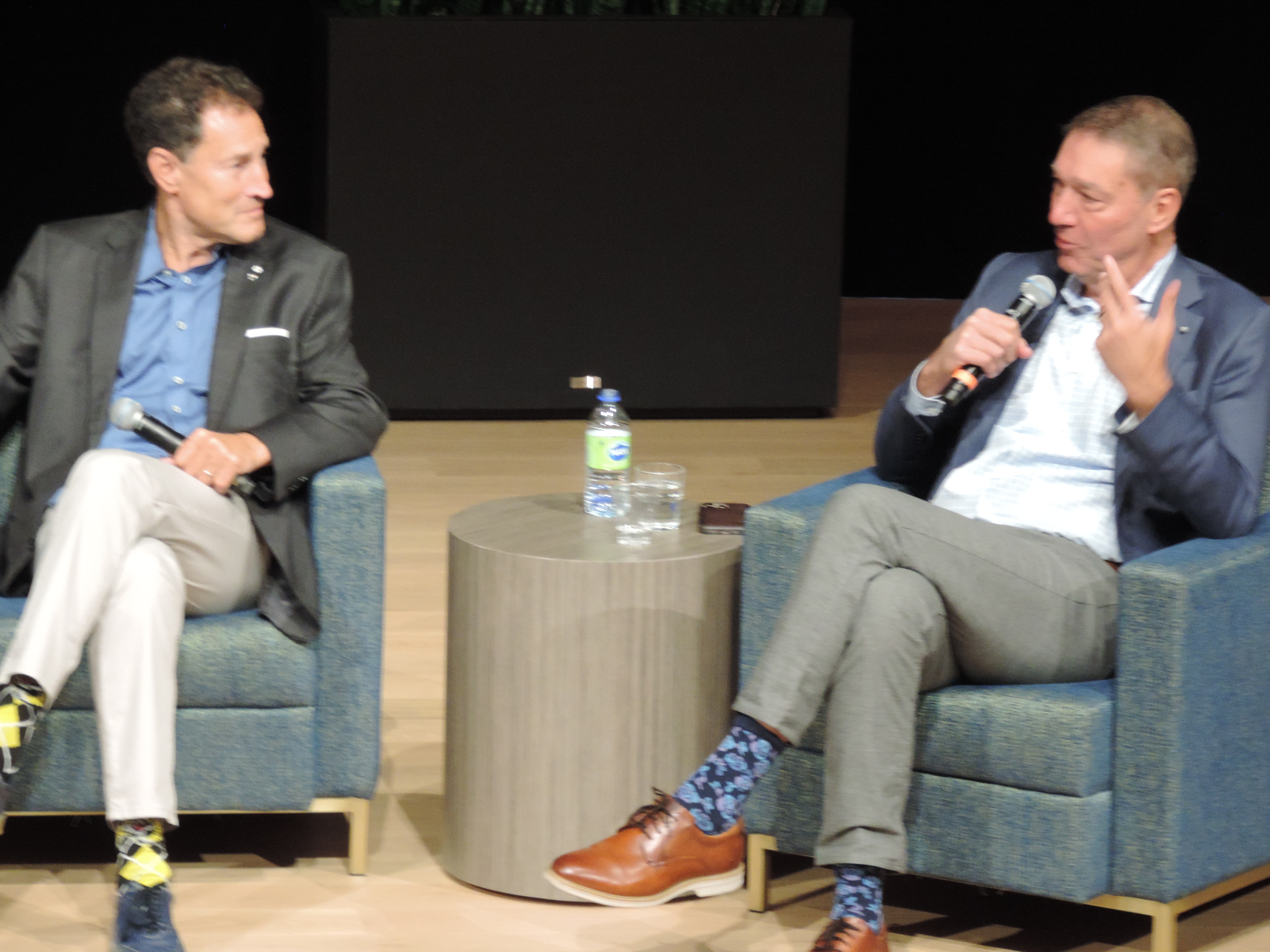
Steve Paikin: I didn’t have to tell them. They knew. With all due respect to Stephen Lecce, who thinks he may be the best education minister we ever had, I won’t make any comment about that. Thank you. I think Bill Davis was probably the best education minister Ontario’s ever had. He was certainly the best premier in my lifetime.
He used to have the saying that if you get education right, everything else falls into place. If you get education right, you’re going to get a better job. If you get education right, you’ll have fewer people on social assistance. If you get education right, you’ll have less need for the justice system—people in courts—the environment. It all starts with education.
He became the Minister of Education at the age of 32, I think. He wasn’t that far removed from it when he actually got in there. He managed to create the whole college system when he was the Minister of Education. They had such a boom at that time. He used to open three new schools—for a year, he opened three new schools a day, all over Ontario.
Artificial Intelligence
Moderator (Rex Taylor): Oh, well, that was going to be one of my questions. What about AI in education—in schools like Pickering, high schools, elementary schools, universities? We’re at a really interesting point because the horse has left the barn, right? It’s not going back. The genie’s out of the bottle. We’re not going to put it back in there. So we have to begin to deal with it.
And I note that there are some universities in the States that have fully embraced AI, said, “Yeah, bring it. We’ll make this work. We’ll change how education can happen.” And there are other universities, of course, that are going back to paper-and-pencil exams in order to ensure that the kids are doing what they’re supposed to be learning—what they’re supposed to be learning.
And there was a study done, and it was reported—and I saw it, of course, on social media, so I have to be a little careful with this. The guy set an exam for his students, and they almost all came out with A-pluses. And he knew something was wrong there. So he made them all rewrite a similar exam with paper and pencil, and of course the marks were skewed way down to the bottom, except for two or three who were actually the good students who studied and deserved to have their A-pluses. And so that kind of lesson, which has been spread around, makes a lot of people who are professors and teachers in schools and all the rest of it want to go back to basics, for lack of a better word.
Steve Paikin: Maybe I could share this story. A few weeks ago I interviewed the minister of education for the country of Estonia, who happened to be in Toronto. And…
Moderator: You meet a lot of people.
Steve Paikin: The minister of education for Estonia. And what was great about it was her people reached out to me and said, “She’s going to be here. She’s doing it in Toronto. We’d love it if you’d interview her for your podcast.” And I said, “That sounds right up my alley. Let’s do it.” So we did it.
And The Paikin Podcast drops twice a week, (laughter) and please like and subscribe. Anyway, if you go to wherever you get your podcasts—YouTube, Apple, Spotify, StevePaikin.com, whatever—you’ll find it there. It just dropped today. And I thought she was brilliant. I don’t know if she’s right or wrong, but I thought she was brilliant.
And funnily enough, I thought she had a lot to talk to Canadians about because, well, let’s put it this way: Estonia has been living next to a very belligerent neighbour who’s much bigger than it for a long time. Funnily enough, so are we now. So there may be a few lessons to be learned there.
But she says two things. Number one, where much of the rest of the world is taking AI and smartphones away from students in the classroom, they are not in Estonia. She thinks it’s still a valuable tool, channelled properly, for young people to use to help them be better students, better citizens, better people, more critically thinking people. So there’s that.
And the second thing is that she wants students to get a handle on AI so that they can be critical thinkers as it relates to—and this is where stuff’s getting real—as it relates to being kind of a first line of defence against Russian disinformation, Russian bots, Russian attempts to disinform these students against their own country. Russia: 160 million people. Estonia: 1.3 million people. It’s not quite as bad as 330 for the US and 40 for us. I mean, sorry—it’s way worse than 330 for America and 40 for us. So I don’t know. I thought that was kind of intriguing and worth considering.
Moderator: I’d be interested to know how she’s hoping to do that, because there are a lot of people who are hoping to do that.
Steve Paikin: Listen to the interview. (laughter)
Moderator: Oh, okay. Very interesting. And where do I find that, Steve?
Steve Paikin: That’d be at StevePaikin.com.
John Taylor: You know, I mean, thinking about it, I have to say I’m not certain. And I don’t think we know the answers yet, right? How do we adjust AI in terms of testing, or how do we use it in the classroom, or don’t use it in the classroom? There’s a lot to be figured out yet.
But at its very basic level, to what the minister in Estonia [said], I don’t want to give it up. I love asking my phone, “What is the population of that place? How long did that [unclear]?” I love that. I grew up in a household where every dinner-table conversation ended up pulling an encyclopaedia off the shelf: “Go get the encyclopaedia.” That was so easy, right? Because you can get information so quickly.
I think it is—yeah, we’ve got a lot to figure out. There are a lot of challenges and some real dangers, but I’m on the side of AI. I want to see how we can embrace this. And I go back to my pet project, which is that because of what AI is or does—or even, frankly, before AI, just the ability to look things up quickly and voice-activate it,
Moderator: Wikipedia?
John Taylor: This is a time where we can embrace the less fact-based parts of work: the challenging of ideas, the prodding of why you think that way. I’d rather see a student in a room [unclear].
Because I say to my kids a lot, “You don’t debate facts. You just go get the fact. You debate ideas.” So let’s debate ideas. Let’s test each other’s thought processes. Let’s understand critical thinking. And are you employing critical thinking? Are you being consistent in your argument? That’s where it matters.
Back to Basics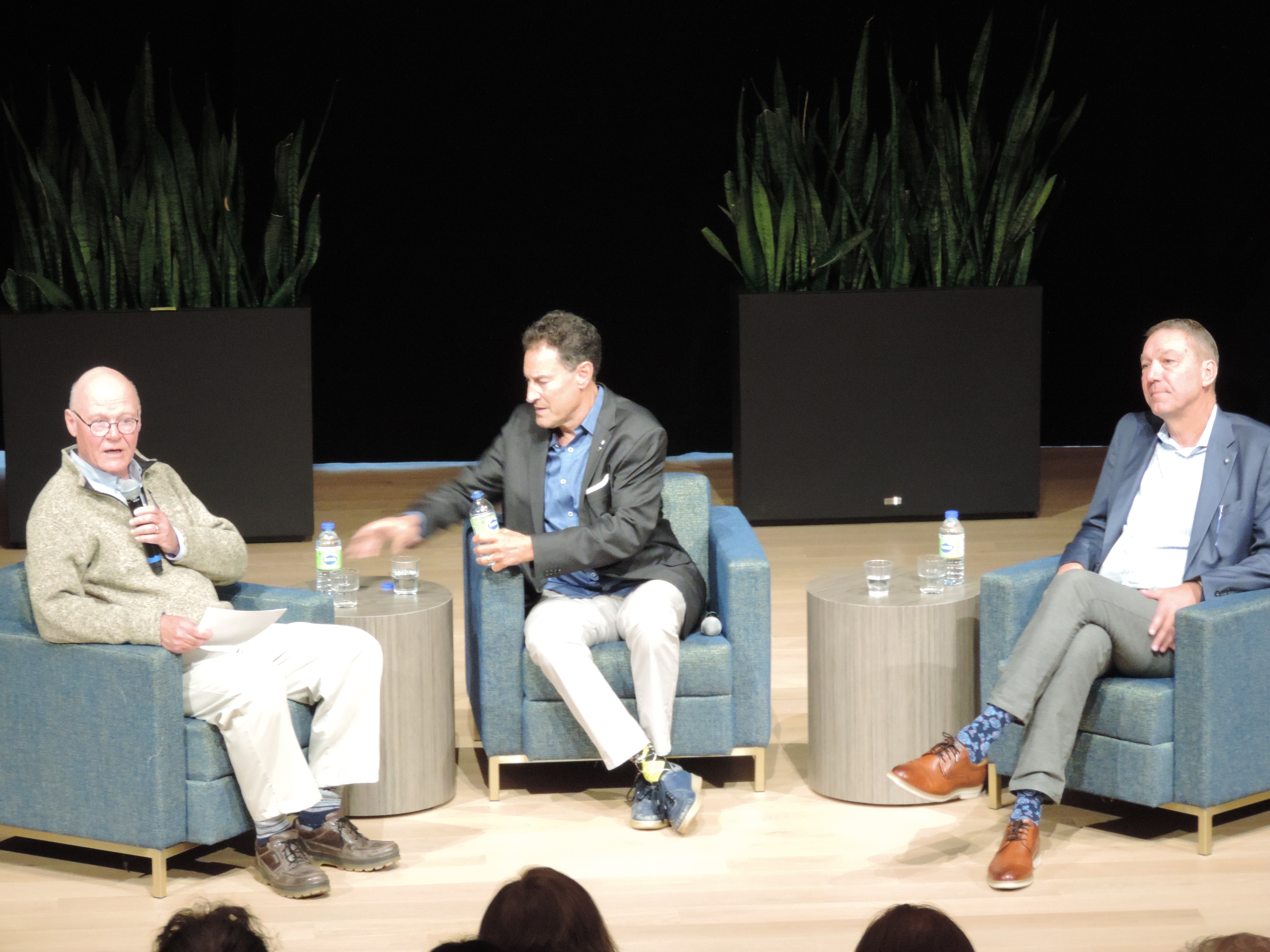
Moderator: And of course, the Ontario government is launching “back to basics” and everybody has to write exams at the end of the year. And you get marks for attendance. Some of those things may be very good, and there are a bunch of other ones that may be very valuable.
So there are sort of two parts to this. What do you think about this idea of back to basics, as much as you might know? And then the other follow-up question, which is, I think, more important in many ways around the changes that are coming to public education, is the loss of local control, or the erosion of local control—local boards of education. So, do you want to start on that?
John Taylor: Yeah, sure. I think we can start at the end: local control. This is [unclear] an idea I’ve heard talked about much, maybe even a [unclear], but I think one way to quickly solve that would be to have education under regional, single-tier [government] level. And then, for one thing, you have a very direct representation, and you know who to go to when you’re unhappy with something.
Moderator: So you’re saying boards of education would be under regional government?
John Taylor: Yeah. Boards of education under regional or single-tier [government], yeah.
Moderator: Okay, so there’s a new idea.
John Taylor: And then I think all the things you said about investing in education, investing in our teachers, investing in… But at the end of the day, it’s what’s going on in the classroom and how they’re doing it. And part of that is to invest in teachers enough and invest in schools enough. Maybe they’ll have the latitude to do more of the things I talked about around creativity and passion and curiosity. But that’s where we might invest. What those things need to get to is that change in education.
A lot of it simply isn’t that. Here’s the thing. Think about it: if you’ve got an education system—and I’m going to make it [unclear], but I’m not far out—where every day we send our kids off to [school], and 80% of those kids would say, “I don’t want to go there,” if that doesn’t say to us we’ve got some work to do, what does? Of course, I know kids will sometimes always say things, but there’s a certain core truth to what I’m saying.
And I think it’s because when you see examples of it here, or in one classroom or in one location, where someone or some system knows how to pull those students in, and just watch [unclear]—you see kids’ faces light up with excitement over what you’re discussing or what they’re doing, or the activity you’re doing, or you’re going to the farm. That’s the game changer. So that’s what we need to aim for. The rest of it is tools to get there.
Steve Paikin: I was talking to a teacher about some of these issues just the other day, in fact. And her point to me was—and I don’t know if she’s right or wrong, but I’ll throw it out there for the purposes of people thinking about whether it’s right or wrong—her point was: “Okay, so a new emphasis on the basics, and a determination by the minister to make attendance matter, and a refocused effort to get kids back into school.” And her point was, “Shouldn’t we instead be focused on the reasons why they don’t want to be in school right now?”
Moderator: Exactly.
Steve Paikin: And maybe put some effort towards figuring that out and deal with it in that respect. Because—and I don’t mind saying it—one of my kids, my youngest kid, was in terrible trouble. She just did not like her school, cut classes as often as she could. She turned out okay, but she was—you know, things were a little dicey for a while there. And I couldn’t figure—her mom and I couldn’t figure it out. And…
Trump and decency and civility
Steve Paikin: Yeah, the general consensus I run into is that Donald Trump is a symptom of something that already existed. Frankly, I’m not that interested in that question anymore—whether he’s the symptom or whether he’s the cause. We’ve got to fix it. I mean, it’s enough already. We really do have to stop it.
And part of that—you folks all know Christine Elliott. She used to represent this area, I think, at Queen’s Park. And Christine Elliott has started a group here in Ontario—I think she’s taking it across Canada—called Decency Matters. I believe the whole thing started in the United Kingdom, and she’s now brought it over to Canada. And we’ve had a couple of meetings on it. She just wants to re-establish, not just in politics but in all walks of life, the notion that we’ve got to get decency back at the centre of everything that we do, and that you’re just not allowed to be a horse’s ass 24/7 anymore. You really have to try to model some better behaviour. Otherwise, the result is what we have right now, which is not sustainable. This is just—you know, most of what we see that passes for politics and public discourse today is a disgrace, and we’ve got to turn that around.
Moderator: John, are you going to say something?
John Taylor: Absolutely. But there’s another part to that as well, which is that—and again, we started with this long before Donald Trump. I remember once being in a McDonald’s lineup 25 years ago, and there were some kids in the lineup and they started dropping F-bombs everywhere. And everybody just started [unclear]. Twenty years before that, every person in that lineup would have told that child how to behave.
And so when we talk about Decency Matters, we keep thinking, “Well, these elected officials have to behave more decently,” or “The people coming to public meetings have to.” We all [do]. It’s awkward as all get-out, let’s face it, but when somebody is doing or saying something that is completely inappropriate, the other part of the equation is the person that just happens to be sitting at the table saying, “Hang on a second here. That’s not okay.”
Moderator: You know, I [thought] about a little anecdote, and this may be an urban myth, but I believe it’s true. I think it was Mayor Koch of New York City, and the subways were covered with graffiti and they were unsafe in New York City. So he started a campaign to clean up the subway cars. They cleaned all the graffiti off the subway cars, and they had these roving crews. As soon as somebody tagged a subway car, it was removed. And that was nice because it was pleasant to sit in the cars and it wasn’t gross and all the rest of it. But crime went down—petty crime on the subway system. People were safer.
So, I think that one of the things that I’ve been thinking about with respect to this is that it’s not—it’s not—yes, it’s Trump, but it’s not Trump. It’s about all of us having to deal with the things that come up that we know are not civilized.
Steve Paikin: But when the leader of the free world sets the kind of example that he sets, everybody takes note and everybody says, “Oh, okay, this is the new normal. This is how we’re allowed to behave now.”
Moderator: But if we don’t see that as an acceptable set of behaviours, we have to do something about it, and we have to start at home, I guess, is what I’m trying to get at.
Steve Paikin: Here’s the thing. Two quick stories on that. Number one: I’m on the subway one day in Toronto, and some guy dressed in very goth-like, you know, makeup, black chains, piercings, gets on the subway with a boombox and is playing it, just blasting. And I say to myself, “What am I going to do here? What am I going to do?” You know, I’m 66 years old. He’s probably 25. He can kill me with one hand. He’s probably got a knife on him. What am I going to do?
And I had the temerity to walk up to him and say, “You know, if we all did that, this would be pretty uncivilized. I don’t think you’re allowed to do that.” To which he flipped me the bird, told me to fuck off, and walked away. Okay, I consider that I got off easy. He didn’t stop doing what he was doing.
I had another friend that I used to work with at TVO, who’s now 76 years old, who was on a streetcar in Toronto one day. Same situation: four young kids dropping F-bombs like crazy, playing their music extremely loud. And he walked up to them and said, “We’re in a public space. You can’t behave like that.” Right? Two black eyes later—
Moderator: They beat him up?
Steve Paikin: Yeah, they beat him up.
Moderator: Well, I think my point—you have to be careful about what you do, right? Like, we can’t step over the line. I mean, believe it or not, your story about the boombox on the subway—our son-in-law is about six foot three and was, at one time, an MMA fighter in his recreational time. And that happened to him on a subway. He asked the guy to turn the boombox down and he didn’t, and so Anthony picked up the boombox and threw it off the train, onto the subway station. (laughter) That sort of solved the problem. But Anthony was six foot three and 25 years old when he did that, and he wasn’t 76 years old and didn’t suffer black eyes.
John Taylor: But to me it goes, though, to this division of politics even—and I don’t mean spectrum politics, just “this is my position”—that’s yours, you know, there’s… it’s… So maybe you don’t want to engage somebody who could be dangerous, a complete stranger. But what happens if somebody in a social setting refers to a teacher at your school, and all the parents are sitting there, and calls them an “effing idiot”? What do you do? What do you say?
Or here’s an example that’s real right now. There’s all kinds of people—and you alluded to them—[who] said about e-devices. Well, somebody’s sitting there and says, “Oh yeah, my kid has one of those souped-up ones, and they’re 13,” and, you know, et cetera. Do you say, “But that’s illegal”? Or do you go the other way? [Unclear] getting back to some sort of sense of civility—what is acceptable, not acceptable. And part of, I think, the challenge we have is that we’ve all pulled back so much. There’s no intervention anymore. There’s no normalizing. There’s no bringing things back to centre.
Erosion of democracy and education
Moderator: So, let’s talk about education. It is well established—a lot’s been written about the fact that the erosion of democracy is actually strongly associated with weaknesses in education. And that’s, of course, pretty much a hot topic. Education systems that fail to foster critical thinking and provide equal access—you know, [people need] to be able to get to schools and get the kind of education they need—become vulnerable to disinformation and authoritarian appeals, and they disengage.
So we’re talking about voices and education. How can public education systems address this? Because I think Pickering does a really good job here. And you look at Alex (a Pickering teacher) back there in Grade 5—I mean, [he] won an award for [unclear]—and many of the other independent schools do. But we know the reality of many of the public system schools—not all, but some, and in some sectors of it—that’s a different thing altogether. So how do we begin to address that? And that’s a big question.
John: Well, first I’ll say that Alex has had his students in to see me, and me in to see his students, on more than one occasion. So, I think that’s a good start, is to just… I think for too long education hasn’t had the community in—bringing voices in, bringing people in, bringing perspectives in…
Changing the Voting System 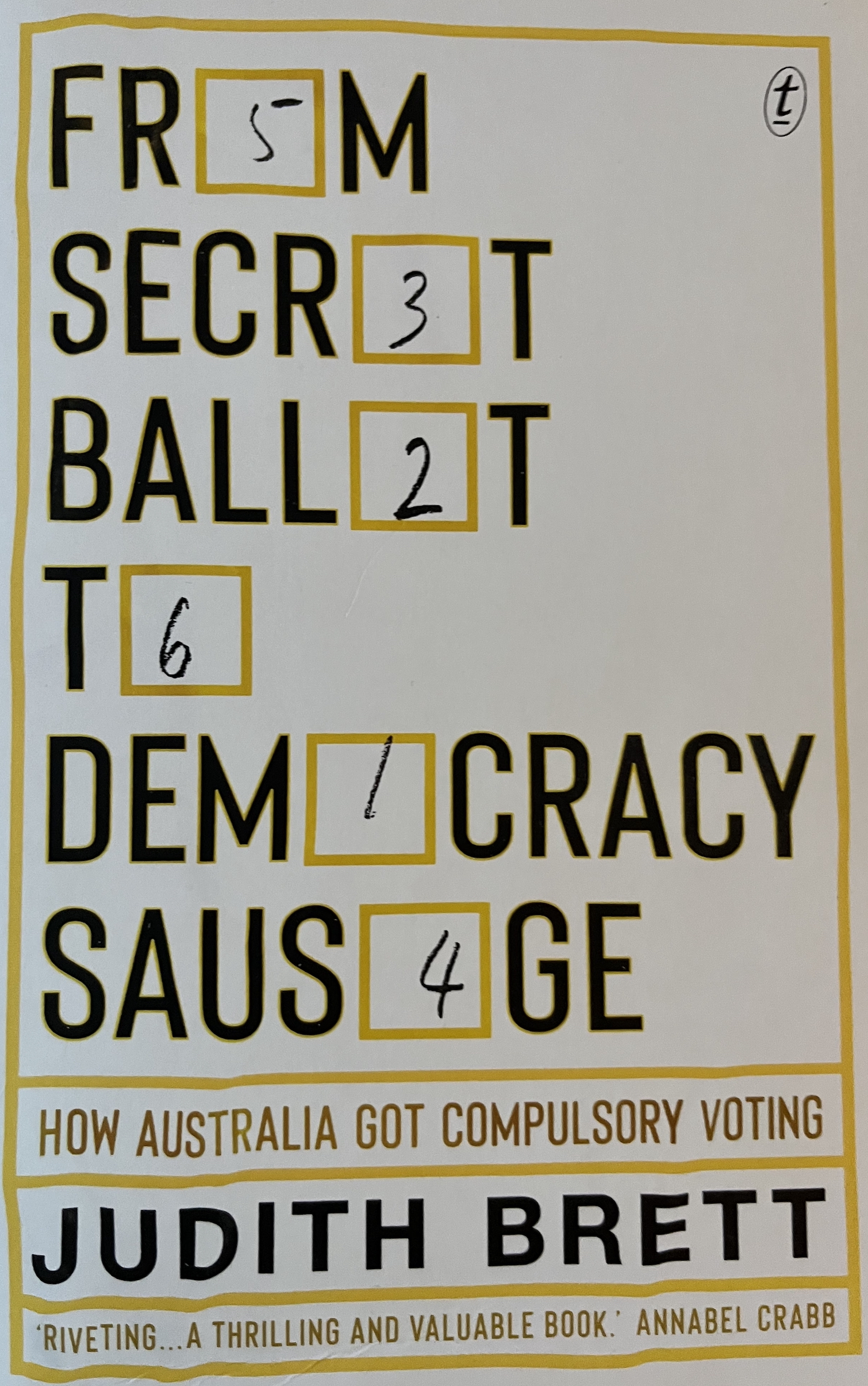
Leah Taylor Roy: …and I’m a politician taking a forced sabbatical right now. (laughter)… I’ll just throw it in because I know it’s a really small topic—changing our voting system so the things you were talking about don’t happen, where we have a ranked ballot or a different system where our votes do actually count.
Steve Paikin: Okay, this is a hard one for me to answer with you, because I think—were you not part of a government that promised to change the voting system and then bailed on it?
Another voice: Ooh, snap.
Leah Taylor Roy: No, no, no, no, I wasn’t. I was an independent MP that came in after that promise was made. But I did call the Prime Minister on it because I think we should have done it.
Steve Paikin: Yeah, okay. So everybody knows what I’m talking about, right? Justin Trudeau promised to change the voting system. He said, “This is the last first-past-the-post [election] we will have in Canadian history.” And then he put Maryam Monsef, I guess, on the case to try to come up with a new system. And she did, and nothing happened.
And I feel like—I’m not sure—but I think that probably was the beginning of the end of the connection that that Prime Minister had with the Canadian people, or certainly with a big chunk of the Canadian people. I mean, he got re-elected after that commitment was over, but with the lowest percentage of the total vote ever, I think, of any Prime Minister who won an election. But to me, that started the beginning of what many members of the public said was a breach of faith between the Prime Minister and them.
And yeah, I’d be very much in favour of taking a grand look at how we could elect politicians differently. I think there are lots of Liberals in Alberta who feel that their vote counts for nothing because that province has, whatever it is, 24 Conservatives representing them in Parliament. I think there are probably lots of Conservatives and New Democrats in Ontario, even in the days when the Liberals were winning 98 out of 99 seats in Ontario, who think to themselves, “My vote doesn’t count for a damn thing.”
And what’s the guy—is it Peter MacLeod? Is he the guy who just wrote that book about putting together a citizens’ assembly?
Leah Taylor Roy: Democracy’s Second Act.
Steve Paikin: Sorry?
Leah Taylor Roy: : Is it Democracy’s Second Act?
Steve Paikin: That’s it, Democracy’s Second Act. Yeah, he’s Catherine McKenna’s husband. Catherine McKenna’s husband. And yeah, it’s an idea about just putting some ordinary citizens together in a citizens’ assembly and putting them to work, and having them look at it. They’ll come up with something better. I have no doubt that they will. And it’ll have more legitimacy than probably what we have right now, unfortunately.
Regulating the internet
Moderator: John, can you comment on the regulation of the internet?
John Taylor: Well, yeah. I mean, again, all the time people will say, “Well, you know, government shouldn’t be interfering in that or regulating this or that or the other thing.” I mean, whether you like it or not—frankly, I like it—government regulates all kinds of things. And the vast majority of those, most people, if they really think about each individual one, are darn glad they do. Like how fast you can drive, right?
So [I don’t think] regulation is inherently a negative thing or something that needs to be wiped out or reduced dramatically. And so I would say, whether it’s AI or the internet, absolutely there’s a role for government regulation. That, to me, is the easy part. Because how and why and to what degree? Because I am a massive, massive believer in free speech, and the power of free speech, and the role it plays in democracy. And so that’s the tricky part. And that’s going to become a much bigger conversation in the next year or two with the whole AI conversation, how rapidly that’s moving. Because there’s a need for us to look at—and government to regulate—in this area. But it’s moving so fast that we’d better start having our conversations a lot faster too.
The arts in Newmarket
John Taylor: I’m happy to say a few things about this. I think—no, there’s a few people in the room that know I’m deeply passionate about the arts in Newmarket, and reinvigorating the arts and funding the arts.
And we’ve had just, I think, an amazing amount of progress the last decade in the resurgence and reinvigoration of the arts in Newmarket. And some of that’s been very strategic. The Town invests in local artists and art. We buy art, we employ musicians, et cetera, et cetera.
And one small example—and it may not be universally applauded—but one small example is my golf tournament. There’s a golf tournament that always gives out scholarships to each public high school in Newmarket. It goes to high-performing academic students, and as of the year before last, they now all go to students in the arts.
Steve Paikin: I couldn’t agree with you more. To me, one of the saddest developments that’s happened in education in the last ten years is that when schools start to feel the crunch, the first thing they do is cut music. And that’s terrible. It’s the exact opposite of what you should be doing.
Electoral Reform (again)
John Taylor: So I’ll just start by saying that I’m really relieved by that question, because I thought you were going to [unclear]. So I know for sure—I’ve read up on it, I’ve looked at the Australians—and I’m a fan of mandatory voting. It’s not perfect, but it’s better than what we’ve got right now. So there’s one example.
Steve Paikin: I’ve spent a whole career not taking public positions on issues that are controversial, because if I have to cover them on the program that I did—or do—I’ve got to be seen as a neutral person. However, we had a provincial election—I don’t think it was the last one; I think it was [the one] before that—where, for the first time I think in my lifetime, we had less than half the people vote. And you have in Queen’s Park, under those circumstances, a government that got, whatever, 40% of the 48% who voted. So you’ve got 100% of the power based on 21% of the actual votes. I mean, this is getting dangerously close to illegitimate, right? So maybe mandatory voting is the way to go to get people out there.
John Taylor: I can give a localized example of that. So in this upcoming election—and this isn’t just Newmarket—but there will be [unclear]. So if we just establish a $250–300 million budget, some very significant decisions that [unclear], including how safe your water is. If you’ve got, for example, five candidates running in a ward, and voter turnout is 28%, it’s very conceivable that that person will be placed on council with 28% of 28%. Or another way to look at it is, in a population of 95,000, their mandate is 600 people.
Steve Paikin: Not good, yeah. We had that in Toronto, actually. On the other side of the [street?], just north of where I live, we had an election for Toronto City Council. And there’s—oh gosh, I don’t know—150,000 people who live in each ward in Toronto, something like that. But there were 19 candidates in that race, and the winner won with 19% of the total vote, and it was 25% turnout, right? So do the math. That’s not good. I mean, what kind of legitimacy do you have when you show up on council when you’ve got 19% of 25%?
John Taylor: Now, I should be careful throwing stones, because I got zero votes, (laughter) but I’ll leave that for you.
Voting as a “civic duty”
John Taylor: I want to get it in tonight, and there might not be another opportunity. You just spoke about it—about taking a note, making sure people vote as part of civic duty. I don’t want to pretend that voter turnout at 80% will solve the challenges we’re talking about. It will certainly help. It won’t solve them, but it will certainly help.
But here’s what I would say on this topic, because it drives me crazy: whenever we talk about voter turnout, people will say, “Well, you know, people are disenfranchised,” or “They don’t care,” or “They don’t believe anybody,” and, you know, “There’s no reason to believe anything’s going to change.” And, you know, maybe all of that’s a little bit true. But every one of those things—and I can name three or four more phrases like that, I’m sure you could—every one of those is also an excuse handed to people not to vote.
And so, you know, the number one way to get people to vote isn’t those things. It’s maybe having a conversation about the fact that the reason someone didn’t vote is because they didn’t vote. So maybe it’s time to just call it out and say, “Hey, don’t tell me your excuse. Go vote. If you have to, cross an X on the page, but [unclear].” I think we have to, at some point, when we talk about this lack of voting, have a conversation about the fact that all these things we talk about don’t get to the point that the person who didn’t vote is a person who could have voted.
Devolving Power to Municipalities
Moderator: …would you devolve more power to municipalities, change the Constitution so that municipalities are not creatures of the province anymore? Would you do the shift, as you said, of school boards to regional governments?
John Taylor: Let me start, because Steve can’t say this... You can, but not as easily. And I don’t know exactly what my wish is, but it has to do with media and the importance of local media, the importance of [people] absorbing a wider range of news and information. So somehow, for me, it’s about information, news, media, commentary. It’s probably one of the biggest ones after education, which will take longer.
Steve Paikin: It’s interesting that you went to media, because I was not going to go to media. I was going to go to education. And I don’t know, I just went with the first thing that popped into my head, which was more teachers, more educational assistants in the class, a richer educational experience for students, a rededication to teaching civics, a better understanding of our democracy and how it works.
Take your kids to vote whenever you vote. I always took my kids to vote. How about this? This is weird. I have four kids. I practiced a particular type of child abuse when they were young, where I dragged them off to political events all the time. Whenever I voted, I said, “Now, you can’t tell anybody how Dad votes, but this is called voting, and you have to do it, and you’re a citizen.”
And I remember Julia, when she first got her first vote, she was a student at Queen’s. She turned 18 and, for whatever reason, she didn’t get on the voters’ roll. She got to the poll and she wasn’t there. She called me from Kingston and said, “I’m not on the list. What do I do?” And I said, “Well, you’ve got to bring some identification that shows your name and address. Bring a hydro bill, bring a rent cheque, bring something that shows that.”
“Oh, okay.” She runs home. She made a hell of an effort to get what she had to get to go and vote. And I was never more proud of her, that she would undertake such an effort to do all that.
Let’s exercise our brains
John Taylor: …conversations and debates and discussions that let’s exercise our brains, and let’s be curious, and let’s be creative. I think that realm needs to hold a bigger place in the education system, and that will do a lot, in my opinion, to foster democracy and democratic freedom in the classroom and in this community.
Moderator: I know Dr. Lock (the principal of Pickering) would agree with you in that particular regard. Go ahead. This is almost a segue into my next question, but go ahead.
Steve Paikin: You may know I’m a bit of a fan of the man who was the Minister of Education in the province of Ontario in the 1960s.
Moderator: Yes, I do. Better share who that might be for the audience, just in case. Who was that?
Steve Paikin: I didn’t have to tell them. They knew. With all due respect to Stephen Lecce, who thinks he may be the best education minister we ever had, I won’t make any comment about that. Thank you. I think Bill Davis was probably the best education minister Ontario’s ever had. He was certainly the best premier in my lifetime.
He used to have the saying that if you get education right, everything else falls into place. If you get education right, you’re going to get a better job. If you get education right, you’ll have fewer people on social assistance. If you get education right, you’ll have less need for the justice system—people in courts—the environment. It all starts with education.
He became the Minister of Education at the age of 32, I think. He wasn’t that far removed from it when he actually got in there. He managed to create the whole college system when he was the Minister of Education. They had such a boom at that time. He used to open three new schools—for a year, he opened three new schools a day, all over Ontario.
And on that note… the Financial Accountability Office of Ontario today reported:
In the 2026 Ontario Budget, the Province projects that Ministry of Education spending will increase from $42.7 billion in 2025-26 to $43.4 billion in 2028-29, representing an average annual growth rate of 0.6 per cent.
-
- This is a significantly slower pace than the 5.6 per cent average annual growth over the previous three years from 2022-23 to 2025-26.
- For context, over the 36-year period from 1990-91 to 2025-26, Ministry of Education spending grew at an average annual rate of 3.2 per cent. If the Province’s Ministry of Education spending plan in the 2026 budget is achieved, it would be the slowest three-year growth rate since 1995-96 to 1998-99.
- Compared to the Ministry of Education spending plan in the 2025 Ontario Budget, the spending plan in the 2026 Ontario Budget has decreased by a total of $0.5 billion from 2025-26 to 2027-28. This includes spending reductions of $0.1 billion in 2025-26, $0.3 billion in 2026-27 and $0.1 billion in 2027-28.
- The FAO estimated Ministry of Education spending from 2026-27 to 2028-29 that would be required to maintain 2025-26 service levels. Also known as a cost driver projection, this scenario does not recommend how spending should change but serves as a benchmark to show whether the 2026 budget’s Ministry of Education spending plan is likely to maintain, improve or reduce the quality and accessibility of education services.
- Overall, the FAO estimates that Ministry of Education spending would need to grow by an average annual rate of 2.1 per cent over the next three years to maintain current service levels.
- The 2026 budget spending plan is below the FAO’s cost driver projection by $0.7 billion in 2026‑27, $1.2 billion in 2027-28 and $2.0 billion in 2028-29. This means that, to maintain current service levels, the Province will need to implement program efficiencies (i.e., provide the same level of services with less resources) and/or commit additional funding beyond what was planned in the 2026 Ontario Budget.